A CEO said to me, “My team is working nonstop. But it feels like we’re running in place.”
Calendars were full. Initiatives were everywhere. Meetings stacked on meetings. No one was idle. And yet, progress felt fragile.
That is the difference between being busy and being designed for scale.
Busy organizations operate on effort. Designed organizations operate on clarity.
I worked with a company that prided itself on hustle. Every leader owned multiple initiatives. Every quarter brought new priorities. The board admired the energy, but quietly worried about sustainability.
When we stepped back, the issue wasn’t commitment. It was architecture.
There was no clear hierarchy of decisions. No sequencing of change. No discipline around what truly drove enterprise value.
So activity multiplied. But momentum did not.
When an organization is designed for scale:
- Work reinforces itself
- Decisions build on each other
- Leadership energy compounds
When it is only busy:
- Effort fragments
- Priorities compete
- Leaders exhaust themselves
We redesigned focus around three enterprise-level priorities. Everything else had to support one of them or stop. The shift was immediate. Fewer projects. Stronger execution. More confidence.
The organization did not slow down. It finally started moving forward.
This is what Enterprise Value Architects understand.
Scale is not created by adding work. It is created by designing coherence.
Being busy is a symptom. Being designed is a strategy.
Enterprise value grows when the organization becomes easier to run as it grows, not harder.
Key Takeaways for CEOs
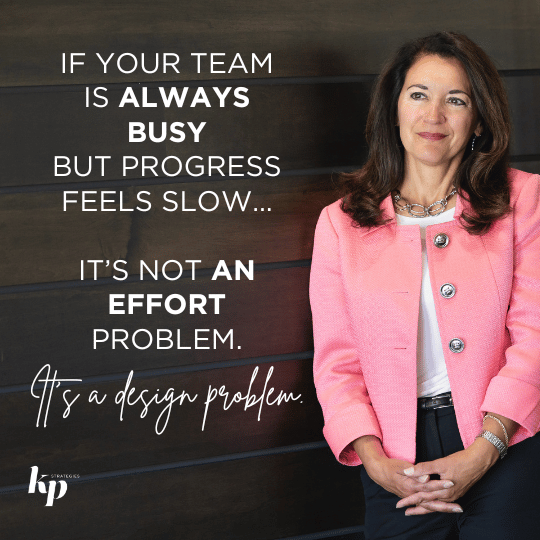
- If your team is exhausted, the system is misdesigned.
- Your job is not to drive activity, but to design focus.
- Fewer priorities create stronger execution.
- Scale should lighten leadership, not burden it.
- Enterprise value grows when work aligns instead of competes.
Key Takeaways for Boards
- High activity is not proof of effectiveness.
- Ask whether the organization is built for coherence or chaos.
- Encourage fewer priorities with deeper impact.
- Boards create value by protecting focus.
- Architecture turns effort into momentum.
Busy consumes energy. Design multiplies it.
And the difference between the two defines whether growth becomes strain or strength.