A board member once said to me, “We’re trying to help. But it feels like every meeting adds one more thing.”
The intention was good. Each request made sense. Each new priority felt responsible.
And yet, after every board meeting, the CEO walked out carrying more, not clearer. The leadership team felt pressure, not alignment. Momentum slowed, even as activity increased.
That is how boards accidentally add complexity.
It rarely happens through bad governance. It happens through well-meaning governance that lacks architectural discipline.
A new risk triggers a new report. A new opportunity adds a new initiative. A concern creates a new metric. Urgency turns into expansion.
Soon, the organization is trying to do everything, which means it is doing nothing exceptionally well.
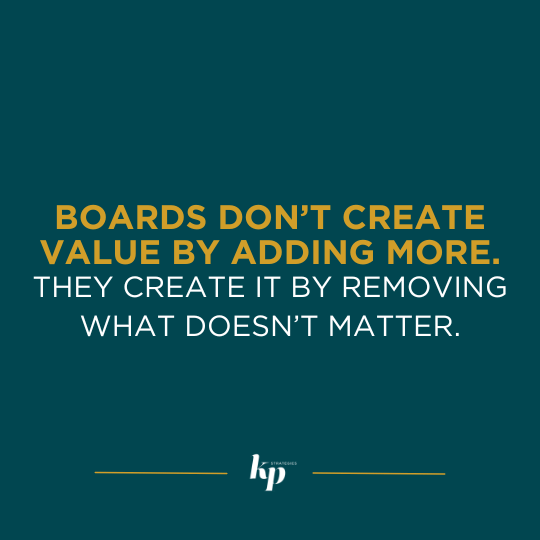
I worked with a board that realized their greatest impact was not what they added, but what they removed. They made one rule: every new priority had to replace an existing one. Every request had to connect to enterprise value. Every agenda item had to serve a decision.
The tone of the boardroom changed immediately.
Fewer topics. Deeper conversations. Stronger alignment. Less exhaustion.
The CEO finally felt supported, not stretched.
This is what Enterprise Value Architects understand.
Complexity is not caused by growth. It is caused by accumulation without discipline.
Boards add complexity when they:
- Layer priorities instead of sequencing them
- Ask for more reporting instead of clearer decisions
- Reward activity instead of outcomes
- Push urgency without removing anything
Boards reduce complexity when they:
- Clarify what matters most
- Protect focus
- Enforce prioritization
- Design tradeoffs
The board’s role is not to make the organization work harder. It is to make the organization work better.
Architecture is subtraction as much as it is design.
Key Takeaways for CEOs
- If every board meeting adds work, clarity is missing.
- Invite your board to help you remove, not just add.
- Complexity is reduced by prioritization, not effort.
- Enterprise value grows when focus is protected.
- Your leadership becomes lighter when architecture becomes stronger.
Key Takeaways for Boards
- Every new request should replace something else.
- Ask what should stop before asking what should start.
- Your influence increases when you simplify.
- Boards create value by protecting organizational capacity.
- Architecture is discipline, not expansion.
Boards do not strengthen enterprises by adding weight. They strengthen them by removing friction.
And when boards embrace that responsibility, enterprise value begins to compound with clarity and intention.