I was working with a leadership team during their annual planning session when I asked a simple question.
“What are your top three priorities for next year?”
The answers came quickly.
- Growth.
- AI.
- Talent.
- Consumer experience.
- Operational efficiency.
- Innovation.
- Customer retention.
Within minutes, the whiteboard was full.
The CEO stepped back, looked at the list, and smiled.
“I think we’ve just proven we don’t have priorities.”
That moment reminded me of a pattern I’ve seen throughout my career.
As organizations grow, priorities tend to multiply faster than leadership capacity.
Every initiative has merit.
Every opportunity looks important.
Every leader can make a compelling business case.
The challenge isn’t identifying good ideas.
The challenge is deciding which good ideas won’t move forward.
That’s where great CEOs separate themselves.
They understand that strategy is as much about what you choose not to do as what you choose to do.
Every new initiative requires leadership attention.
It demands organizational capacity.
It competes for resources, talent, and execution.
Saying yes to one priority almost always means saying no, or at least not now, to another.
Yet many organizations avoid those conversations because tradeoffs are uncomfortable.
I’ve found the opposite to be true.
Tradeoffs create clarity.
They align leadership teams around what matters most.
They give employees confidence about where to focus.
And they dramatically improve execution.
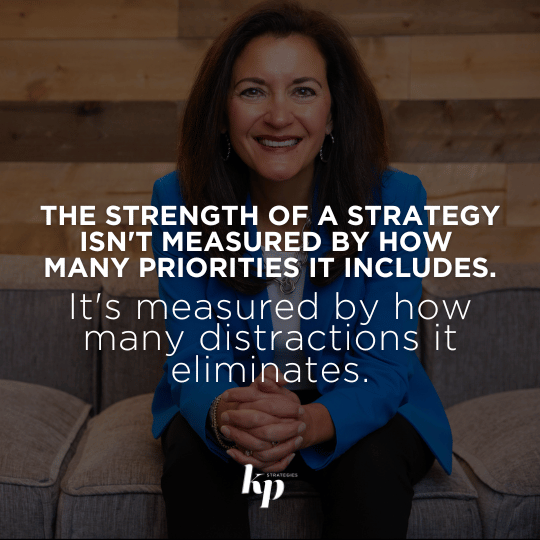
The strength of a strategy isn’t measured by how many priorities it includes. It’s measured by how many distractions it eliminates.
That’s one of the clearest patterns I’ve observed working with CEOs.
CEO Takeaways
- Strategy isn’t about identifying more priorities. It’s about making better tradeoffs.
- Every yes should come with a conscious decision about what won’t receive the same attention.
- Enterprise value grows when leaders focus the organization on what matters most.