I was meeting with a CEO who couldn’t understand why decisions were taking longer than they had a year earlier.
- The leadership team was stronger.
- Revenue had grown.
- The company had hired great people.
On paper, everything pointed in the right direction.
Then the CEO made an observation.
“It seems like everything important still comes back to the same three people.”
That was the problem.
I’ve seen this pattern repeatedly as organizations grow.
High performers earn trust because they consistently deliver results. Naturally, they become involved in more decisions, more projects, and more customer relationships.
Over time, they become indispensable. At first, it feels like a competitive advantage. Eventually, it becomes an organizational constraint.
Decisions begin to wait until they’re available.
Teams hesitate to move forward without their input.
Important work slows, not because people lack capability, but because the organization has unintentionally concentrated too much knowledge and authority in too few leaders.
The irony is that your strongest leaders rarely create this situation intentionally.
They want to help. They care deeply about quality. They’re accustomed to solving problems.
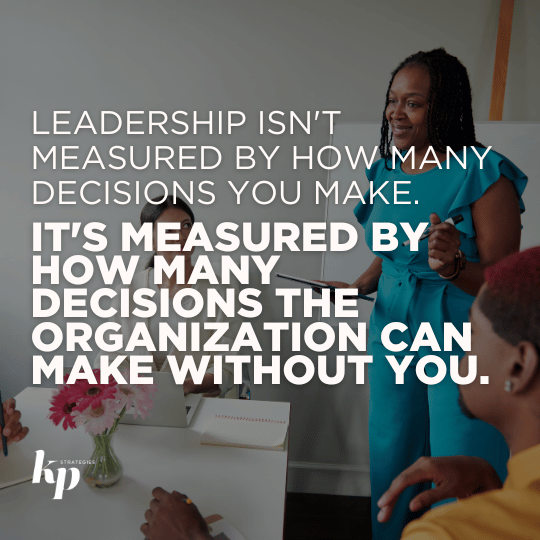
But as the business grows, leadership isn’t measured by how many decisions you make.
It’s measured by how many decisions the organization can make without you.
The CEOs who scale successfully recognize this shift before it becomes a bottleneck.
They develop leaders instead of heroes.
They create decision clarity instead of decision dependency.
And they build systems that allow great people to multiply their impact rather than become the center of every important decision.
The goal isn’t to become indispensable. It’s to build an organization that no longer depends on you for every critical decision.
That’s one of the clearest patterns I’ve observed working with CEOs.
CEO Takeaways
- Watch for high performers who are becoming decision bottlenecks instead of leadership multipliers.
- Create clarity around decision ownership so the organization can move with confidence.
- Enterprise value grows when leadership capability is distributed, not concentrated.