A CEO said to me, “I feel like every important decision eventually lands on my desk. I can’t move fast enough to keep up.”
The board saw it too. The CEO was sharp, decisive, and deeply committed. But meetings kept circling the same issues. Progress slowed. Energy drained.
Not because the CEO lacked capability. Because the organization was built to depend on them.
When decision ownership is unclear, everything escalates. When governance is weak, authority flows upward. When architecture is missing, the CEO becomes the system.
That is how great CEOs turn into bottlenecks.
I worked with an organization where nearly every major decision—strategy, capital, technology, talent—came back to the CEO. The leadership team deferred. The board expected certainty. The CEO became both architect and traffic controller.
It was unsustainable.
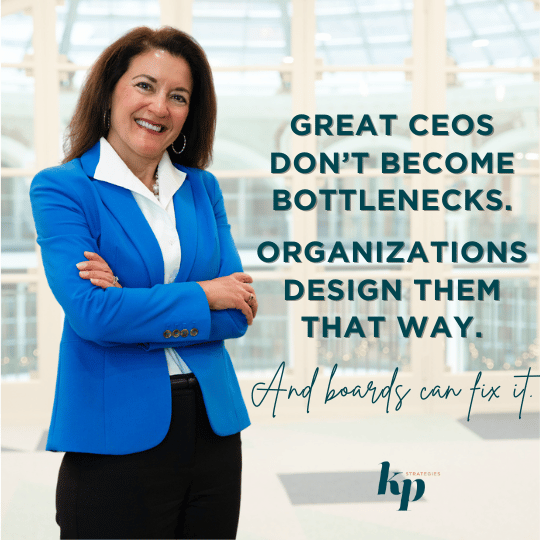
The solution wasn’t delegation. It was design.
We redesigned the decision architecture:
- Which decisions belonged to the board
- Which belonged to the CEO
- Which belonged to the First Team
- Which belonged to functional leaders
Clarity replaced escalation.
Within weeks:
- Decisions moved faster
- The leadership team stepped up
- The CEO regained strategic capacity
- The board shifted from pressure to partnership
Nothing magical happened. The enterprise simply learned how to decide.
This is what Enterprise Value Architects understand.
When CEOs become bottlenecks, it is rarely a leadership failure. It is an architectural one.
Strong organizations distribute authority intentionally. Weak ones concentrate it accidentally.
When everything flows to the CEO:
- Decision velocity collapses
- Leadership capacity shrinks
- Enterprise value erodes
When authority is designed:
- Momentum increases
- Accountability strengthens
- CEOs lead, instead of carrying
The CEO’s role is not to decide everything. It is to design how decisions are made.
And the board plays a critical role in that design.
Boards that help CEOs stop being bottlenecks do three things:
- They clarify which decisions truly belong at the board level
- They reinforce decision ownership across the leadership team
- They support the CEO in building a decision architecture that scales
That is governance as leadership.
Key Takeaways for CEOs
- If everything comes to you, architecture is missing.
- Your role is to design decision flow, not absorb all decisions.
- Decision ownership expands leadership capacity.
- Bottlenecks are created by structure, not strength.
- Enterprise value grows when authority is intentional.
Key Takeaways for Boards
- A CEO bottleneck is a governance signal, not a performance issue.
- Strong boards help design decision architecture, not just review outcomes.
- Clarify what belongs to the board, what belongs to the CEO, and what belongs to the team.
- Governance becomes leadership when it frees the CEO to lead strategically.
- Enterprise value compounds when decision-making is distributed by design.
Great CEOs should never be the system. They should be the architects of it.
And when boards help design that architecture, the enterprise becomes faster, stronger, and far more scalable.