
A CEO said to me after a board meeting, “We passed every audit. But I still hesitate before making big moves.”
The organization was compliant. The controls were in place. The reports were clean. And yet, something was missing.
Confidence.
Compliance tells you that rules are being followed. Confidence tells you that the enterprise is ready to act.
There is a profound difference.
In many boardrooms, risk is still discussed primarily through the lens of avoidance: Are we protected? Are we covered? Are we compliant?
Important questions. But incomplete ones.
The more powerful question is: “Does our governance create confidence to act, or caution to wait?”
I worked with a board that realized its risk conversations were unintentionally slowing the company down. Leaders were cautious not because the strategy was flawed, but because ownership of risk was unclear. Decisions felt heavy. Accountability felt fragmented. No one was quite sure who had the authority to say, “Yes, we can move.”
So risk became something to manage around, not something to design through.
When they reframed digital and operational risk as part of enterprise architecture, everything shifted. Instead of asking only how to reduce exposure, they asked:
- Where does confidence need to exist for the company to grow?
- Who owns risk when decisions cut across functions?
- How does governance enable speed, not just safety?
Risk stopped being a brake. It became a stabilizer.
This is what Enterprise Value Architects understand.
Risk governed well does not constrain leadership. It strengthens it.
Compliance protects the business from failure. Confidence enables the business to grow.
When confidence is high:
- Decisions move faster
- Innovation becomes disciplined
- Leadership feels supported, not restrained
- Enterprise value compounds
When confidence is low:
- Decisions stall
- Opportunities shrink
- Boards grow cautious
- CEOs hesitate
That is not safety. That is stagnation.
Strong boards design governance that creates confidence by:
- Making risk ownership explicit
- Integrating risk into enterprise strategy
- Clarifying where authority lives
- Enabling leaders to act with conviction
The goal of governance is not to eliminate risk. It is to make intelligent risk-taking possible.
Key Takeaways for CEOs
- If you hesitate despite compliance, confidence is missing.
- Risk governance should make you bolder, not more cautious.
- Clear ownership of risk creates decision freedom.
- Enterprise value grows when confidence replaces fear.
- Leadership strength is measured by clarity, not caution.
Key Takeaways for Boards
- Compliance is a baseline, not a strategy.
- Ask whether governance enables leaders to move with confidence.
- Clarify who owns risk when decisions cross functions.
- Strong boards build trust in decision-making, not just control.
- Enterprise value grows when confidence becomes a design outcome.
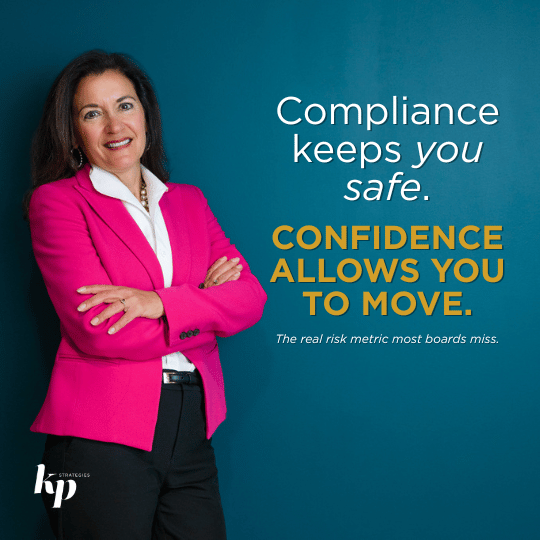
Compliance keeps you safe. Confidence allows you to move.
And in today’s environment, the organizations that win are not just protected. They are prepared to act.