A CEO asked me recently, “Is governance just another word for repeatable process?”
It’s an honest question. And it usually shows up when a company begins to scale.
Someone says, “We already have a process for that.” But no one can clearly answer:
- Who owns the outcome?
- Who makes the final call?
- What decision this process is meant to support?
So decisions bounce between committees.
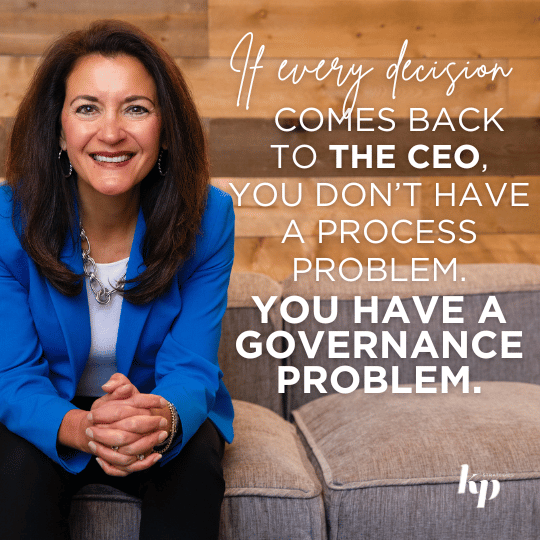
The CEO becomes the default decision-maker.
Boards ask for more reporting.
Leaders add more process.
Everyone stays busy. And progress slows.
Those are not process problems. They are governance gaps.
Governance is not policy. It is not documentation.
It is not a workflow.
Governance is the decision architecture of the enterprise.
It defines:
- Who decides what
- How accountability is set
- How risk is owned
- How decisions connect to enterprise value
Process comes after this.
Process executes decisions.
It does not replace them.
I watched a leadership team struggle for months trying to “fix” execution by adding process. What finally unlocked progress was not a better workflow. It was a single moment of clarity:
“So we don’t need more process…we need clearer decision rights.”
Exactly.
Within weeks:
- Decisions accelerated
- Friction dropped
- CEO fatigue eased
- Board conversations sharpened
Not because the organization worked harder.
Because it finally knew who owned what.
This is what Enterprise Value Architects understand.
Process improves efficiency.
Governance creates momentum.
When governance is weak:
- CEOs become bottlenecks
- Boards drift into activity review
- Decision velocity collapses
- Enterprise value erodes quietly
When governance is strong:
- Leadership capacity expands
- Decisions become clean and fast
- Scale becomes sustainable
- Enterprise value compounds
Here is the distinction that unlocks everything:
Governance defines who decides. Process defines how work gets done.
When those two are aligned, clarity replaces coordination.
Speed replaces hesitation.
Strength replaces strain.
That is architecture.
Key Takeaways for CEOs
- If everything comes to you, governance is unclear.
- Stop adding process when what you need is decision ownership.
- Your role is not to absorb decisions, but to design how they flow.
- Enterprise value grows when clarity replaces control.
- Strong governance makes leadership lighter, not heavier.
Key Takeaways for Boards
- If meetings are filled with activity updates, governance is underperforming.
- Ask who owns decisions, not just how work is done.
- Governance is about shaping direction, not reviewing process.
- The board’s highest value is in clarifying authority and accountability.
- Architecture begins when the enterprise knows who decides.
Governance is not bureaucracy. It is the design of leadership itself.
And when it is done well, scale becomes simpler, not harder.